

#

Quiet. Please.

When a sound wave hits a surface, part of it is reflected, another part is absorbed by the surface material (converted into heat). This loss of energy is called absorption.

The degree of sound absorption is described by the αs figure and expresses the ratio of absorbed energy to incident energy. It is calculated according to frequency from 125 Hz to 4,000 Hz (in 6 octave values). A value of 0 corresponds to total reflection, a value of 1 to total absorption. Measurement is made according to DIN EN ISO 354.

Sound absorption is therefore very important, as it can be used to control the complex sound behaviour in a room.

As a rule, carpets are excellent sound absorbers and achieve values of up to 0.90 αs, depending on the frequency, which means that 90% of the sound energy is absorbed.

In comparison: with hard flooring, sound absorption generally lies at a maximum of 0.5 to 0.10 αs (= only 5–10% of sound energy is absorbed).

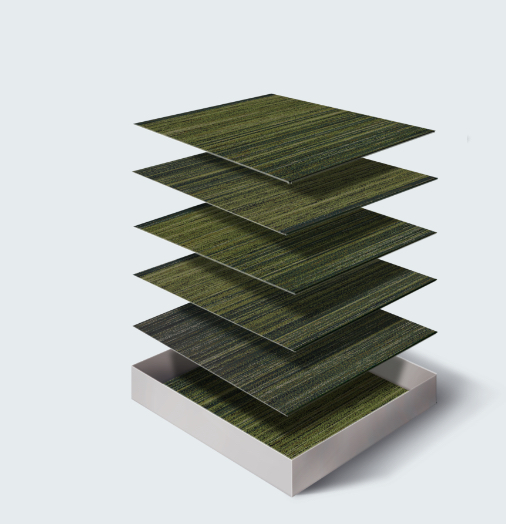
When carpets are also finished with special acoustic felt, sound absorption can be further improved by a factor of 4–5 in the lower frequency range at 500 Hz–1,000 Hz. This often helps to avoid expensive measures making use of acoustic fittings.

Depending on how a room is to be used, a recommended optimum reverberation time is aimed for. It is the time that passes until the sound level in a room drops by 60 dB. Reverberation occurs as a result of repeated sound reflections, which constantly become weaker with time. For rooms where musical events are held, it lies between 1.5–3.0 s, in offices at around 0.55 s.

By using appropriate products with adjusted sound absorption capacity, it is possible to achieve the required reverberation time.